SELECTED WORK / CASE STUDY
APPLIED AI / KNOWLEDGE SYSTEMS
Tech Radar.
Save a link. Build a body of evidence.
Tech Radar turns the habit of saving interesting tools into a repeatable research and publishing workflow.
Public findings + RSS
Git-backed research
TECH RADAR / PUBLIC FINDINGS
A feed with follow-through.
Sep 27, 2026
reviewBlock's open-source workspace for people and agents; worth tracking as a coordination interface.
Sep 27, 2026
reviewMeituan's audio-driven avatar model is available through the LongCat-Video repository; bookmark for a scoped future evaluation, with compute requirements still to assess.
Sep 27, 2026
stronga writing-editing skill for spotting generic phrasing while preserving a draft's meaning and voice.
01 / THE BUILD
The starting point
Saved posts are easy to accumulate and hard to evaluate later. A useful finding needs the original context, evidence about the tool, and an explanation of where it could fit in a real project.
02 / THE BUILD
The experience
01
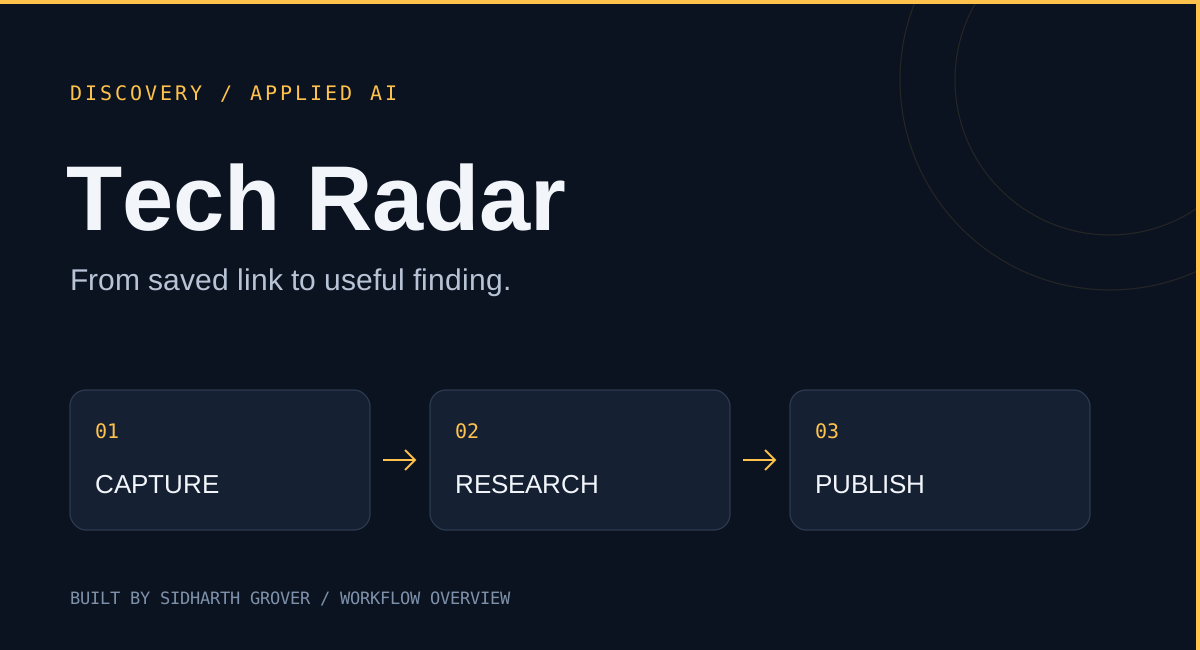
Submit a URL through the web interface, Telegram, an iOS Shortcut, or the API.
02
Extract source text or transcripts and research the underlying technology.
03
Record evidence quality and a project-specific implementation idea.
04
Publish a structured finding to the knowledge base and browse it through the public Radar.
03 / THE BUILD
Under the hood
A TypeScript/Fastify API orchestrates extraction, Claude-powered research, and project-fit analysis. Findings are written as Markdown to a Git-backed knowledge base. The Next.js portfolio consumes a validated public API and provides search, evidence filters, and RSS discovery.
Store research as inspectable Markdown
Git-backed findings preserve a reviewable artifact outside the interface. The public feed can be rebuilt from the knowledge base rather than becoming the only place the research exists.
Separate capture from evidence
A social post can introduce a tool without establishing its claims. Extraction retains the source context; research and evidence labels make the remaining uncertainty explicit.
Keep reading available when processing is not
The public portfolio validates the feed and uses a committed fallback if the API fails. Readers can continue browsing without depending on a new extraction run.
BUILT WITH
TypeScript
Fastify
Claude
Zod
Python
GitHub API
Next.js
Railway
04 / THE BUILD
Making it dependable
Serialized processing prevents concurrent Git writes from racing.
Schema validation and an offline snapshot keep the public feed available when the API cannot be reached.
Evidence labels distinguish stronger source material from findings that still need review.
PROJECT STATUS
The API runs on Railway and the public findings feed is live on this portfolio.
KEEP EXPLORING
Explore all projects